
Grading v. Assessment
There's a difference?!

In this following post, we’re going to talk about all things assessment. That’s right, “assessment” not “grading”. Why is that an important distinction? Keep reading to find out!
What is Assessment?
Assessment is the collection, synthesis, and interpretation of data whose findings aid in pedagogical decision making.
What is it not?
Grading! Grading is about evaluation—judging performance based on a (often arbitrary) standard.
Why do we do it?
Assessment allows both us and our students to track their growth and assess the success of our instructional strategies. If something isn’t working, we can fix it early on by eliciting feedback from our students and encouraging them to reflect on their own learning.
High vs. Low Stakes Assessment
A variety of graded (high stakes) and ungraded (low stakes) assessments will help us and our students meet our course goals by tracking student learning across modules. These forms of assessment are also referred to as formative (high stakes) and summative (low stakes) assessment.
Now we all understand the difference between these two forms of evaluation. Ever have issues getting students focused or trouble encouraging active discussion? Check out this graphic and the below description to understand why low stakes assessment in particular are good options to limit student stress and increase participation!
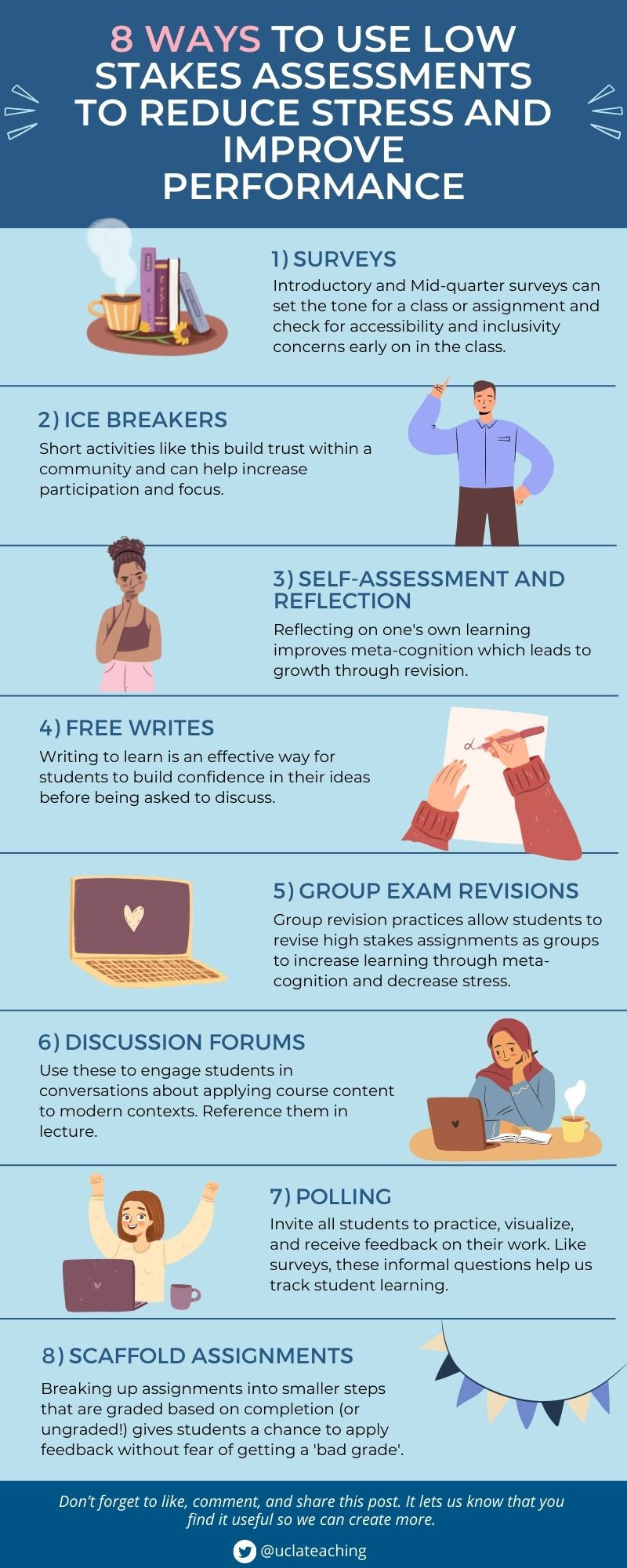
8 Ways to use Low Stakes Assessment to Reduce Stress and Improve Performance.
Introductory and Mid Quarter Surveys or Diagnostics
Surveys can be designed using Google Forms and are easily distributed to students via BruinLearn or email. They should be kept short and provide space for students to respond in prose to concerns they have for the upcoming quarter, assignment, or past class periods. Introductory surveys can be used to collect information such as preferred name, pronouns, or access to technology and stable internet. Mid-quarter surveys can help identify what is working and what is not working in the class. By offering students a chance to review the class and share their concerns early, you as the instructor have the chance to respond to students' stressors and/or make changes to your class plan. Students will feel heard and respected and this will build trust between you, as their instructor, and them, thus increasing student participation!Ice Breakers
Ice-breakers are short activities that provide space in the classroom for students and educators to get familiar with one another. They can be as simple as asking how students are feeling to more complex activities. Caroline recommends these two lists of icebreaker questions: 32 Fun Zoom Icebreakers and List of Icebreaker Questions. Taking time at the start of class to perform an ice-breaker gives students time to bring their focus to the class and leave their other worries outside. Increasing focus and building community are sure to improve student performance!Self Assessments and Reflections
Prioritizing student reflections in the classroom allows for the development of meta-cognitive skills like critical thinking and problem solving. Students who reflect on their work (and/or that of a group) encourages a growth mindset with which students learn to understand struggle as opportunities for learning and development.
*For more information on growth versus fixed mindset, check out Carol Dweck’s research.Free Writes
I use free writes for everything: Brainstorming, self-reflection, ice-breakers, reading journals! They are easily set up as a single question in a Google Form with an open response. Google Form then collects names/emails and collates the information in an easy to read format. Using Free Writes before a discussion gives students time to think about their responses before being asked to verbalize their thoughts; using them as ice-breakers help students focus on class and review any previous work they may have completed before coming to class. Free writes are your friend!Group Exam Revisions and Peer Review
Allowing students to review their exams as groups (or even take their exams as a group!) helps limit stress and encourages meta-cognitive thinking. Students reflect through discussion with their peers why certain answers are “correct” or where there is missing information. Understanding where mistakes or errors are made and being allowed to make improvements or correct responses encourages a growth mindset.
Peer review benefits student learning in similar ways as expressed above. Allowing students to work together to understand how improvements can be made encourages a growth mindset. Rather than students believing that turning in an assignment is all there is, allowing for revision encourages them to reflect on their work and improve it.Discussion Forums
Many people, instructors and students alike, HATE discussion forums. They often result in copy-paste responses by students rather than true discussions. Fortunately, there are ways of making discussion forums fruitful! I myself have created student-moderated discussions where students were asked to center a discussion around a few primary sources and a student-moderator was responsible for encourage discussion among participants. There are many great examples of how to organize a discussion forum effectively in this 5-part series on discussion forums.Polling / In Cass Response Systems
Our students come to us with a rich background of knowledge and experience. You can add their voices and activate this sharing by using polling tools in your teaching. Prior knowledge, muddiest point, and even honest dialog can all be achieved! It also gives us a better sense to see how students are engaging with their learning.
Invite all students to practice, visualize, and receive feedback on their learning. Once you’ve polled your students, you can take it to the next level by showing the students the poll results, then asking them what they notice. This helps students reflect on the data and work together to understand it. Next, you can ask students what they are still curious about based on their classmates’ responses, which often results in a meaningful discussion.
Check out this polling tool comparison guide of tools frequently used by faculty and TAs!Scaffolded Assignments
Breaking arguments down into manageable components helps students familiarize themselves with research and writing as a process. Often students faced with major, high-stakes assignments are unsure where to even begin! By breaking these up for students into bite-size pieces, students are able to practice as they go along and work on both time- and project-management skills. WI+RE, a program at UCLA Library, provides great tutorials and workshops that can be used to help break down these processes for students. I often assign these workshops as student homework either before or after I’ve presented a new writing strategy (e.g., annotated bibliographies, thesis statements, literature reviews, etc.) I’ve received quite positive feedback from students who appreciate the extra instruction they can work through at their leisure.
Additionally, I highly recommend not grading these small assignments or, at least, grading them pass/fail–especially drafts. I have found in my teaching that students appreciate this element of the course more than any other as they are able to practice and experiment with applying feedback without the stress of ‘getting a good grade’ or ‘giving the correct answer.’ When I have graded these elements, I tried to provide an opportunity for students to fix any errors they may have made and I will give them up to half the points they lost back for fixing them.
Further Reading and Additional Resources on Low Stakes Assessment
LSU’s “Active Learning while Physically Distancing” guide
A useful chart that lists various low stakes assessments across different modes including face-to-face, online synchronous and online asynchronous. Encourages viewers to select activities based on teaching goals.
“Alternative Assessment Approaches” from a collaboration of UCLA teaching centers
A table created in Winter 2022 to provide alternatives to high-stakes exams. These continue to be relevant after the switch back to in-person instruction!
“21 Ways to Structure an Online Discussion” (5-parts) from FacultyFocus.com
A five-part discussion on the usefulness of online discussion forums. This series describes a variety of ways to use and organize online discussion forums effectively.
“Keeping Students Engaged: How to Rethink Your Assessments Amidst the Shift to Online Learning” from FacultyFocus.com
An article describing several examples of low-stakes assessments that work both for remote and in-person teaching.
“The Case Against Zeros in Grading” from Edutopia
This article discusses the need to make 50 the lowest score so that “failure isn’t worth more than success”. An important read!
Bruff, Derek. Intentional Tech: Principles to Guide the Use of Education Technology in College Teaching. West Virginia University Press, 2019.
Derek Bruff, director of the Vanderbilt University Center for Teaching, shares examples of what college educators have done “innovatively” in their class that focuses on how teaching and learning goals determine what and how technology is used. He also reminds us that teaching technologies are not always digital, as classroom whiteboards and movable furniture are technologies that can help support student learning.